


It is never too soon to start planning for your retirement. There is no reason your retirement years cannot be the best of your life with proper planning! Tax law changes effective for 2024 allow you to further maximize on your retirement.
Because retirement planning is so robust, we will provide a multi-series to cover the material. This article will focus on Roth IRAs.
Contribution Limits:
Contribution limits for 2024 are $7,000, up from $6,500 in 2023. For individuals 50 and older, you can make an additional catch-up contribution of $1,000. This brings the total possible contributions to $8,000 for 2024, up from $7,000 in 2023. This is a limit that fluctuates annually. Please consult with your tax professional for further information.
The deadline to contribute to a Roth IRA is April 15th of the following year. Because this is retirement plan that can be funded for the prior year up until tax day, this is an after-the-fact tax planning tool that tax preparers can assist with while processing your tax return if it is filed timely enough.
Income Limits:
Roth IRA contributions are subject to income limits. In 2024, you cannot contribute to a Roth IRA if you are single and make more than $161,000, or married filing jointly and make more than $240,000.
There are options for a back-door Roth IRA. A backdoor Roth IRA is a strategy that allows high-income individuals to contribute to a Roth IRA indirectly. This is done by converting a traditional IRA to a Roth IRA. This is a legal way to get around the income limits of direct contributions to a Roth IRA. Please contact your tax professional for more information and guidance if you think this could benefit you.
Required Minimum Distributions:
Roth IRAs do not require an RMD for the original account holder during their lifetime. However, beneficiaries or an inherited Roth IRA are subject to a 10-year rule. The 10-year rule requires the beneficiary to withdraw the entire account balance by the end of the 10th year after the original account owner's death. Distributions do not have to be made years 1-9, but the entirety is required to be distributed by the end of the 10th year. If the funds are not needed, you may want to consider leaving the funds in the account to grow tax-free as they can be withdrawn tax-free in the future. There is one stipulation, however. If the decedent passed and had already reached their RMD age, you will be required to take RMDs based on your age and still have the fund fully depleted by the end of the 10th year following their death.
How is it Taxed?
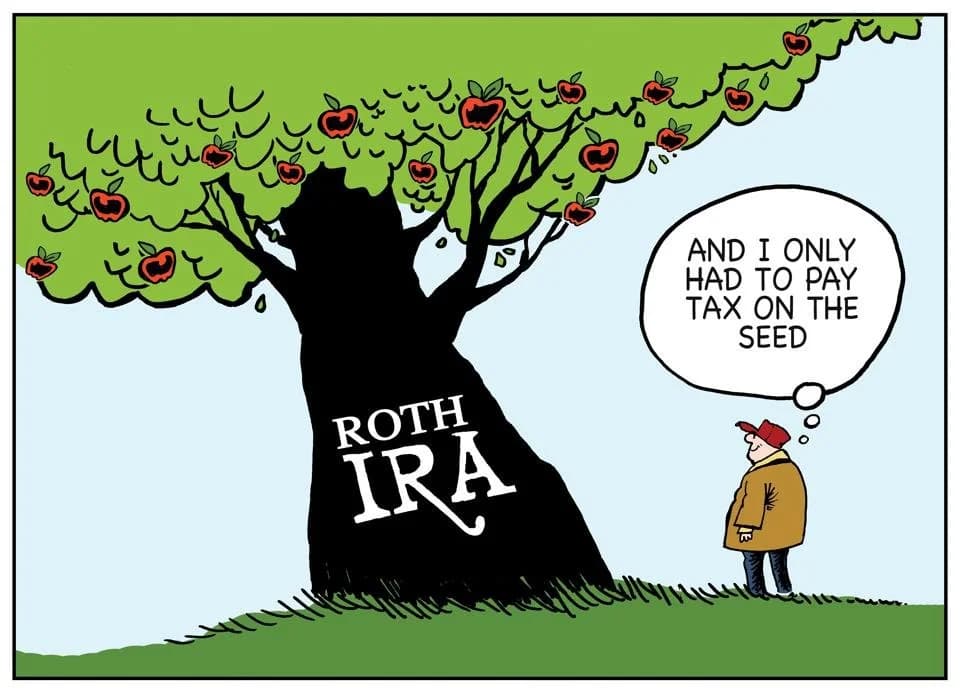
Roth contributions are not tax deductible for federal purposes, meaning the money you contribute is included in your taxable income. However, your EARNINGS can grow tax and penalty free as long as handled accordingly.
You can withdraw from your Roth IRA at any age. Contributions dollar for dollar can be withdrawn at any point in time tax and penalty free. However, if there are earnings on the account certain requirements must be met to withdraw those tax and penalty free. Requirements include: account holder is at least 59 1/2 years old and the Roth IRA must have been held for at least 5 years.
For distribution purposes, Roth IRA withdrawals are considered on a first-in, first-out (FIFO) basis, meaning all withdrawals are initially classified as coming from contributions first, as opposed to earnings.
There is an exception for earnings withdrawals. If you are a first-time home buyer, have qualified education expenses, certain emergency expenses, or qualified expenses related to a birth or adoption you can qualify to withdrawal earnings from the Roth IRA tax and penalty free without meeting the aforementioned requirements for earning distributions. If you feel you meet these requirements please check with your tax professional prior to making the withdrawal to be sure you would qualify.